Out With the Bad, In With the Good

Earlier this week, my family got hit by the flu bug.

You might know the type – vicious vomiting, unsettled stomach, chills and hot spells and other bodily activity uncomfortable even to write about in this blog.

Flu Bug 1Predictably, once one person in the household got it, the destructive beast made its way to the other members of our home.

Thankfully, the flu worked its evil ways but left our family with enough time to recover right before Christmas can be celebrated. Now, we can gather with our relatives and still rejoice in this blessed season, enjoying full health while knowing we are not at risk of infecting anyone.

That’s the silver lining about enduring such a horrendous bout of sickness. Whether it be a virus, food poisoning or any other bug that ravages your system, once it’s gone, you feel so reinvigorated.

The return of a full appetite, a sense of humor, some pep in your step so you can exercise once again – whatever it is, it’s so nice to have. The bad goes out, the good comes in.

God reveals this message, too, through various stages of history in the Bible, reminding us of His love and presence all throughout periods of difficulty.

Whatever the example, He teaches us to stay the course on His path, assuring us we will find greener pastures in our lives. (Psalm 23:1-6)

I was reminded of this recently while reading to our sons the story of Noah’s Ark.

Noah Ark 4I recalled how the world was filled with such sin that God decided to destroy the evil and build His beautiful creation back up again. (Genesis 6-9)

That rebirth and renewal of the world is one example of how God always makes good outcomes of bad happenings, so long as we are open to receiving them.

It’s at this time of year we turn our attention to another instance of God conquering evil.

The birth of Jesus ushers in a new life for all of us to appreciate, empowering us to change our negative ways while inspiring us to return to the perfect form we received at the time of our creation.

New LifeThrough Christ, we see God’s presence always – even in suffering – and we are motivated to recognize how, with Jesus, we can overcome even the darkest of days in order to feel abundant brightness. (Hebrews 2:10)

As He taught during His time on earth, Jesus offers us the way, the truth and the life we require to escape from our struggles or confusion.

Devoting our life to Him can help us feel such rejuvenation, gaining the strength needed to face all of our troubles head-on and put them behind us.

Is There Room in Your Heart?

As the Christmas holidays approach, many people are growing more excited about their vacation plans.

For weeks if not months, those travelling may have their flight arrangements already secured or their road trips marked with routine food stops.

No doubt, they have contacted family or friends, various hotels or bed & breakfast places to see what rooms are available.

As we journey through the Advent season in preparation for Christmas, we can be reminded of the travels Mary and Joseph took from Nazareth to Bethlehem.

Now, keep in mind they travelled by donkey and were not surrounded by the developed highway routes we enjoy today, filled with gas stations, fast food restaurants and convenience stores.

Tired, hungry – and, oh yes, pregnant – Mary and Joseph sought a place where they could rest and prepare for the birth of their child.

No Vacancy Sign 2Turned aside by others, an innkeeper offered them a lowly stable, where the Savior would be born in a manger, surrounded by animals and hay.

Say what we will about the accommodations, that innkeeper made room for Jesus when others declined and closed their doors.

Hearing the Nativity story these next few weeks, we will be challenged to reflect on whether we make room for Jesus in our lives and, if so, how much room.

Is God given our entire heart and included in all of our daily thoughts, words and deeds?

Is He invited in only when we need Him, serving as a safety instrument in time of desperation?

Do we call on the Lord when it’s convenient for us and serve Him only out of obligation or for appearance’s sake, or do we genuinely wish and choose to have God reflected in as much of our lives as possible?

This message struck me head-on the other day while driving to school in the morning. Listening to a song titled Make Room by the group Casting Crowns, I heard powerful lyrics:

Is there room in your heart for God to write His story?

You can come as you are, but it may set you apart when you make room in your heart and trade your dreams for His glory.

The song also describes how Jesus came to save a world so cold and hollow, wanting to free us of all of our sorrows.

Sponge 4If courageous enough, we can reflect on how these messages impact us personally.

While Jesus was born outside with limited shelter, do we envelop Him with our heart each day or mostly cast Him aside?

Jesus gives us His unconditional love, but in return, do we give Him our life unconditionally?

It was this exact point that was discussed during a recent Alpha for Youth session at my high school.

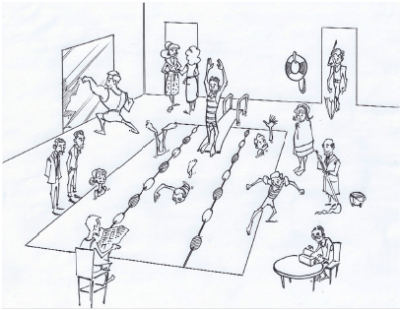
We were looking at a picture of a swimming pool and the people in the photo, comparing the situation to society’s various relationships with God.

Alpha Swimming PoolIf we are to consider the pool to be God, what role of the individuals applies to us?

Are we diving head-first into His loving and healing waters, or just dipping a toe in, reluctant and wanting to enter slowly?

Are we swimming laps comfortably and confidently with God present in our every stroke, or are we on the pool deck, more preoccupied with other matters such as our work or personal appearance?

Are we experiencing a feeling of drowning in our life and reaching out for God to rescue us, or are we exiting the pool, toweling off and leaving Him?

Certainly, there is so much to consider as we approach the blessed birth of Jesus Christ. Yet, as we celebrate the coming of Emmanuel and ready ourselves for another year with His peace available to us, what are we choosing as our Christmas wish?

Remembering how God entered the world as an innocent babe wishing to save, let us be reminded of how – just like hotel rates when trying to book a room the week before Christmas – the cost of a life without God is simply too great.

Is there room in our heart for God to bless us and write His story?

Forgetting the Joneses

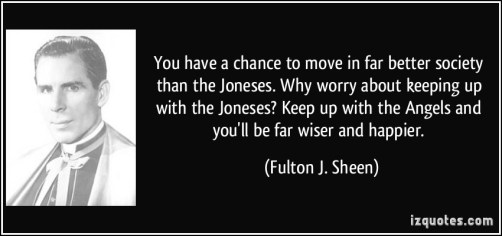
Keeping up with the Joneses.

Keeping up with Joneses 6It’s an expression people use to indicate comparing oneself to another person or group of people, as in a family being envious of neighbors – the Jones – and their possessions.

Yet, it stretches far beyond a family looking next door and desiring a swimming pool in their back yard in order to be as popular as the folks beside them.

In today’s world, so many of us fall prey to this temptation of constantly comparing ourselves in some way to someone that we may or may not know.

Keeping up with Joneses 5It could be their facial appearance or body type, their clothing or car, their social popularity, athletic ability or intelligence. We could pine for their house, their job or their friendship circle, their spouse or significant other.

Whatever it may be, we in society often look at others and can find ourselves wondering, “Why can’t that be me?”

It was this observation a student pointed out in a recent assignment analyzing Jesus’ parable of the prodigal son. (Luke 15:11-32)

In the story, Jesus tells of a son who renounces his father and heritage, demanding his inheritance and later squandering it on immoral behavior.

While the parable teaches the meaning of unconditional love and the value of forgiveness – as shown by the father welcoming the contrite son upon his return – there is also a secondary angle focused on the other son, jealous of his brother’s celebrated arrival. (Luke 15:29-30)

Jesus warns against the evil vice of envy in this lesson and on several other occasions, including his parable of the laborers in the vineyard. (Matthew 20:1-16)

In that teaching, our Lord reminds us to be grateful for our gifts, living humbly without focusing too much on others around us.

While such a task was difficult for many in biblical times – even for St. Peter (John 21:20-22) – the jealousy demonstrated in these stories speaks to the feeling many of us can have in our lives today.

Keeping up with Joneses 3Think about it. How often have you looked at someone else and wished you were them or had something they had? I know I’m guilty of this.

I know, also, that I’ve wrestled with this lack of satisfaction for quite some time, dating back to my middle years of elementary school.

Whether it was another boy’s hockey or basketball talents, their video game system, or their cute looks or funny jokes that attracted all the girls’ attention, I always seemed to compare myself to others.

This struggle with insecurity has continued off and on since then.

Whether it is my skinny body type no matter my exercise or eating, my high school and university grades, my teaching credentials and accomplishments, or my housing situation, I’ve never truly been able to keep from judging myself against another person.

Heck, I’m even envious of my friends who have successful writing careers.

All of this is foolish on my part, of course, as I’ve got much to celebrate without having to look at the proverbial green grass on the other side.

Keeping up with Joneses 2I’m blessed to have a darling wife who loves me for who I am and with whom I have three wonderful children who light up my life.

My family lives in a comfortable townhouse that meets all of our needs and allows us to enjoy a lifestyle offering many privileges and experiences.

I am a high school Religious Education teacher who holds great passion for my vocation, relishing the daily challenge of striving to invigorate the faith life of teenagers.

I have a strong network of close friends who support me no matter what and from whom I learn so very much.

As for my writing, as budding as it may be, well, let’s just say I’m entrusting that to the Lord, asking Him to guide my steps and open doors if they are meant to be opened.

Keeping up with Joneses 1The more I fall into the trap of longing for what others have instead of appreciating what’s mine, the more I lose sight of the goodness I already savor.

Sure, any one of us could easily think our life would be better off with someone else’s wardrobe or popularity, their electronics, bank account or job.

However, if we consider what we have and look at that as a collection of blessings from God, we can humbly realize we have so much to be thankful for and therefore live a life of gratitude instead of regret.

Finding the Right Savings

We are now less than two months away from Christmas and you can bet stores will be flooded with shoppers seeking the best deals for their gift purchasing.

Savings 5Everywhere we turn, we are likely to see or hear about savings.

Whether it be a newspaper flyer, a TV or radio commercial, or an ad on social media websites, many people will give way to temptation to buy and buy some more.

That word – savings – will be just enough to convince some people to pull out their credit card, hand over cash or even sign a cheque, convinced they’re saving money and getting a deal.

Savings 3Make no mistake – I love savings as much as the next person. In fact, I practically do cartwheels in my head each time my wife comes home and tells me she saved a certain percentage or number of dollars buying a product on sale.

But just the mention of saving conjures thoughts of so many things set up to provide benefit or comfort.

Stores regularly provide discounts or sales, encouraging us to buy more while spending less.

Computers constantly save our work, alleviating our fears we will lose important materials.

Safety deposit boxes in banks or safes in hotel rooms ensure our valuables are protected.

Technology is advancing so much that products such as lawnmowers or cooking appliances are becoming more and more efficient and self-reliant, saving us time and responsibility.

Savings 7It seems we spend a lot of time and energy looking for the best option in order to save, yet we can easily forget to seek the best way to be saved.

Recently at Mass, I was struck by a particular hymn, describing Jesus as a worthy Redeemer, mighty to save and author of salvation.

I was reminded of how I often feel a sense of anxiety or panic inside when I’m not in a good place in my faith. Yet, when I return to Jesus in prayer, I grow in confidence, reassured that all will be better and that He is in control.

Truly, our faith teaches God will save us – today and at the end times of Judgment Day.

Savings 6Placing our complete trust in Jesus, then, we are affirmed in our belief He is leading us to ultimate good and that we are and will always be saved.

After all, what else should we expect from our Lord whose name – depending on what etymology you prefer – means God helps, saves, rescues and delivers?

So as Christmas looms closer, I suppose the bottom line lies in deciding what we would rather have if we could only pick one: saving money and getting a good deal today, or being saved by a life with Jesus and receiving an eternity in Heaven.

When we look at it like this, it doesn’t appear a life’s devotion to that blessed baby in the manger is a bad bargain at all.

Operating with Hands and Feet

As a youngster, I used to love the game Operation.

My friends and I would play it, trying with all the focus we could muster to remove various ailments from the many openings in the patient, known affectionately as “Cavity Sam.”

Operation Game 1It was extremely tricky using those tiny tweezers to pull out all of his plastic ailments.

I remember often touching the edges of the cavity openings, setting off that annoying buzzer and lighting up Sam’s red light bulb nose.

Looking at Cavity Sam, his heart and stomach areas were the toughest to operate on, based on the number of objects needing removal.

Broken Heart, Spare Ribs, Wish Bone, Bread Basket and Butterflies in Stomach all filled the main region of his body and would always seem to trip me up.

His hands and feet, by contrast, were far less of a challenge, as there were barely any pieces you had to pluck out with the tweezers.

In examining our lives, while the heart and stomach areas are key parts of the human body, the hands and feet can easily be taken for granted.

I mean, let’s be honest, you can’t do much without your hands and feet.

While not impossible, without these extremities, one’s independence can easily be compromised when doing many activities, such as eating, dressing, writing and moving.

The importance of our hands and feet is stressed even further when considering our faith.

St. Teresa of Avila reminds us of this, describing us as being the hands and feet of Jesus Christ on earth.

St Teresa of AvilaChrist has no body now but yours. No hands, no feet on earth but yours. Yours are the eyes through which He looks compassion on this world. Yours are the feet with which He walks to do good. Yours are the hands through which He blesses all the world. Yours are the hands, yours are the feet, yours are the eyes, you are His body. Christ has no body now on earth but yours.

As we discuss this in my Religious Education classes, I remind my students how we are all called to live as modern-day prophets, sharing God’s Holy Word with the world by living as reflections of His Son and our Savior.

If God is to be present in today’s society, it is up to us to reveal Him.

Hands & Feet 1If Jesus’ presence is to be felt in today’s culture, we must take on the task to introduce and celebrate it, doing so with humility and respect through our thoughts, words and, yes, most definitely our actions.

Volunteer work in the community, financial donations to non-profit organizations, food and clothing provided to shelters for the homeless and blood given to patients in need – these are just some of the ways we can model God’s love and teachings.

But we can also do God’s work through the simplest of acts, such as opening a door for someone, telling the truth, comforting a person when they are sad, using manners, inviting someone to eat lunch or play a game with us, and looking at people in the eye when talking with them.

Hands & Feet 2By preaching our Lord’s Gospel message not only through speech but also through deeds in our daily living, we can better show society the wonder of virtues, while slowly ridding it of destructive vices.

So as we aim to operate our lives in happy and healthy ways, let us always remember to serve as the hands and feet of Jesus, touching the hearts of others and walking in His holy path, paving the way for others to follow.

Let it Boil Over

One of the many things I love about my wife is her cooking.

Catherine is very talented at creating different dishes, mixing various ingredients and preparing meals that are both healthy and tasty.

Boiling Pot 3Sitting at the table for dinner, for instance, I know I’ll be well-nourished and never have a complaint about what I’m eating (unless, of course, she sneaks in a few mushrooms or some coconut oil, hoping I won’t notice).

Another reason I’m so grateful for her cooking is because I’m not very good at it – at all.

I mean, I know I could follow a recipe and I’d be able to survive just fine if I had to cook for myself, but my longstanding repertoire has never really extended far beyond a delicious sampling of pancakes or scrambled eggs, homemade sandwiches, microwaved vegetables and chicken or hamburgers thrown on a trusty barbeque.

Outside of these, there’s nothing much that has ever separated me from frozen TV dinners and take-out restaurants.

When cooking in the kitchen, I might get so flustered or distracted, it’s almost a guarantee any pot I have simmering on the stove will boil over, causing great frustration.

Boiling Pot 2Now, you don’t have to be a culinary expert to know having a pot boil over is a bad thing.

When the top starts foaming up, you better remove the lid or start stirring. Otherwise, your stove flame might go out or, even worse, you could burn your food.

While the simmering technique may be helpful when cooking, it is simply not good enough when it comes to our faith.

Our faith must be stirred, yes, but it must also grow to be so strong that it eventually boils over and is shared with others.

Much like cooking when we check on our food boiling on the stove or baking in the oven, we also need to assess our faith at various points, ensuring we are on the right road, moving forward with the Lord.

If not, perhaps we could stand to be turned over, whisked or poked like food being cooked, in order that God can speak to us in the right way and that we can be fully open to receiving His direction.

But once we’ve come to such a discovery, we then need to turn our stove setting to HIGH and let our belief and faith practice explode from within us, burning brightly for all to experience. (Psalm 39:3)

Boiling Pot 4Having a relationship with God that is so complete and powerful, we can then let it boil over by introducing His love to those we know and come to meet, spreading His Good News each day.

Boiling Pot 1That way, with a heart burning for Jesus and His Holy Spirit, the glow of God’s love can radiate through us and help transform those around us. (Matthew 5:16)

Mirror Mirror

A few years ago, I remember my Dad and I were out for lunch and I was venting frustrations to him about the challenges of being a high school Religious Education teacher.

I was sharing with him the difficulty of promoting God’s greatness to adolescents who, for various reasons, might see God as uncool, uninteresting and unrelated to society.

I revealed how it can occasionally be mentally exhausting and emotionally taxing to stand in front of a group of indifferent or apathetic teenagers each day and talk about how wonderful the Lord is, how He loves them so much and how our world needs Him more than ever.

I told my Dad how deflating it can feel when I see their looks of disinterest and how my passionate personality and enthusiastic teaching style can sometimes yield fruitless results during class activities and discussions, no matter how inspiring my anecdotes or creative my lesson plans might be.

It was after waiting patiently during my rant that my Dad simply took a sip from his soda, paused and then told me I was like John the Baptist.

What? Come again? Have you even been listening to me these last few minutes?

John the Baptist? Uh, no, I don’t stand in a river wearing clothing made of camel’s hair, nor do I eat locusts and wild honey. (Matthew 3:4)

But once my Dad explained his remark, I understood and agreed with his point.

John the Baptist 3John the Baptist’s voice was one crying out in the wilderness, urging people to repent and prepare for the Messiah. (Mark 1:3-4)

Teachers like me, we strive to encourage our students – churched or unchurched, believers or non-believers – to open themselves to God and His daily presence, accepting His love and celebrating His wonder in all they do.

However, this is not a task given just to high school Religion instructors.

In a society that so often tunes out God rather than inviting Him in, we are all called upon to be modern-day prophets in the wilderness, living counter-culturally to proclaim God’s Gospel message.

On my classroom wall, I have a poster of a fish swimming in the opposite direction of the rest of the school.

I reference it often with my students, stressing the message that is included over the picture:

What is right isn’t always what is popular. What is popular isn’t always what is right.

In an age where messages of violence, drugs and alcohol, sexuality, selfishness and egotism are so often celebrated in media and popular culture, it can sometimes feel impossible trying to promote values of respect and peace, chastity, altruism, humility and concern for the long-term common good.

And yet, that is precisely what we are here on earth to do.

Much like the apostles following Jesus’ ascension into Heaven, we are all sent to be the Good News of Christ. (Luke 4:18-19)

Canadian Archbishop Terrence Prendergast (Ottawa, Ont.) wrote in a church publication a few years ago that humanity had a vocation to holiness. He called on Christians to go out into their communities and, led by the Holy Spirit, share with others the experience of Christ’s salvation.

Alarm ClockSt. Pope John Paul II put it even more directly when he once stated bluntly we must wake up the world.

So how do we do this, exactly? It’s not as if we’re going to just walk up to people and sound a ringing alarm clock in their ear.

Strange as it might sound, we can awaken the world by living like mirrors.

You see, we can reveal to others our true self-identity.

Mirror of God 1If we are, indeed, God’s children created in His perfect image, we must live as mirrors of God, reflecting Him to the world through our thoughts, words and actions.

This is not at all easy, and often requires plenty of patience and dedication – as evidenced in a high school Religion class.

But by our humble and persistent example, we can encourage others to ultimately turn away from sin and return to a path leading to Jesus’ eternal light.

Locusts & HoneyNow then, I’m sure I can say more, but I suppose I should head out to the local farmer’s market and see if I can pick up some locusts and wild honey.

Good ol’ Dad

On weekends sometimes, I’ll have an impromptu dance party with our sons in our basement.

We’ll turn on the radio or one of my classic CDs and start jamming to the beat. We’ll do some random exercises, bend our knees, balance on one leg and jump high off the ground.

We’ll even dance in a circle holding hands and then I’ll pick them up and swing them around.

It’s all fun enough on its own, but what makes it even better is when the right music plays.

And what is that, you may ask?

One word: ABBA.

ABBA Mamma MiaYep, I listen to ABBA. I love ABBA.

In fact, I’m not ashamed to admit I was one of the many in audience who got up and danced in the aisles when I saw the musical Mamma Mia! years ago.

With songs like Dancing Queen and Super Trouper to grab attention, you’d be hard pressed to find a more electrified theatre atmosphere.

The Swedish pop group’s greatest hits album Gold always excites me and takes me back to an ABBA cover band concert held on campus during my frosh week, one of my favorite university memories.

But while the group’s name derives from the first letter of each member’s first name, one could wonder what the true meaning of Abba really is.

Well, the word Abba comes from the Aramaic language and translates to mean “father.” More specifically, though, it is used to denote warm affection and refer to God in a relation of personal closeness.

We cover the term in some of my Religious Education classes, studying the intimate relationship Jesus invites us into when He teaches His apostles how to pray. (Matthew 6:9-13)

Jesus uses the term Himself in Scripture, calling for strength when praying in the garden of Gethsemane prior to being betrayed by Judas. (Mark 14:36)

St. Paul also addresses our Father in Heaven as Abba and calls us as Christians to embrace this connection with God by feeling His Holy Spirit within us. (Romans 8:15 & Galatians 4:6)

But even in a less Biblical or scholarly context, one can just imagine the impact of father and compare it to a term more comfortable and intimate, like dad.

While being addressed as “Father” by one’s children can carry a cold, distant or authoritative feeling, having them call you “Dad” (or “Daddy,” as young kids like ours tend to use) can suggest a close, loving and tender connection.

Many of us might even use names of endearment for our fathers, calling them anything from Pops to Big Guy, or referring to them with others as “my old man.”

And just as these names suggest a strong bond, God wishes to have such closeness with us.

After all, as a song by Catholic composer Carey Landry suggests, Abba is the potter and we are His clay, the work of His hands.

Abba PotterAs evidenced by His becoming human in the form of Jesus and His constant Holy Spirit with and around us, God seeks to know us personally.

He longs to be with us entirely, sharing in our hopes and dreams, our fears and worries.

He wishes to be a part of our sports team practices and school performances, our family meals and activities, our jobs and our hanging out with our friends.

The question, then, is do we allow God into our lives and include Him in such a real and complete manner?

Believe it or not, in attempting to grow more intimately with God, we can even lean on the music of ABBA to help.

As the group sings a song titled S.O.S., we can look to Jesus as our rescuer in times of distress, encouraged by the meaning of His name as “God saves.”

Reminded of God’s desire to have relationship with us and for His children to be one with Him, we can apply this sentiment to ABBA’s Knowing Me, Knowing You.

Looking at Lay All Your Love on Me, we can consider how Jesus laid His life down for us and continues to show His love for us through our daily blessings. We can recognize our responsibility to give God our love and to blanket the world with His love.

Lastly, let us never forget how, in the beginning, God saw endless potential in each of us and created us perfect in His image.

Take a ChanceGod continues to help us realize our life possibilities each day and promises that if we devote our lives to Him, we will one day be with Him in Paradise. (Luke 23:43)

Taking this to heart, don’t we owe it to ourselves to Take a Chance on our Abba?

We will Survive

Tomorrow is Sunday.

Ah, Sunday.

The Lord’s Sabbath Day – a day of rest, inviting us to appreciate our blessings by attending church service and offering praise to God for all of His wonder.

Ugh.

Rest? Are you kidding me?

Kids in Church - Sunday CalendarWhoever said Sunday mornings were restful clearly never brought little children to church.

For my wife and me, getting three kids under the age of four dressed, fed and into our mini-van so we can get to 9 a.m. Mass on time (which rarely happens) is a major feat in itself.

Having our kids behave through the church service and not bring us any shameful glares from others in attendance is an even greater miracle.

Looking back, there have been so many instances where I easily wonder, “What on earth were we thinking going to Mass?”

For starters, a dirty diaper at the most inopportune moment is a classic.

Of course, there was the time when Hugh (now two years of age) was just months old. After having just been breastfed and burped, he managed to vomit on the head of his unsuspecting older brother Isaac, who was standing below him, right beside me.

I kid you not, it was just as if a bird pooped on your shoulder as you were sitting on a park bench.

Thankfully, Isaac didn’t notice a thing and remained very calm as I brought him to the bathroom downstairs, rinsed his hair and dried it.

If only our kids were that calm today.

These days, it seems once we are seated after the opening prayer, Catherine and I must immediately dip into our bag of tricks to keep our boys occupied – and quiet.

Thankfully, our five-month-old baby girl Naomi has been supplying the quiet for the most part, remaining very tranquil and often sleeping cooperatively.

Her brothers, on the other hand, are another story.

Despite being fed a full breakfast at home, there are requests for snacks. So, you can be sure we have some options in our kids’ church bag to keep them satisfied.

Cut up cheese, granola bars, apple slices, yogurt tubes, Cheerios – you name it, we’ve given it (while also opting not to bring food).

After that, it’s a revolving door of toys, books and games to keep them busy.

Kids in Church - Good 2Of course, we’ve got to referee to ensure there’s no fighting over who gets what – and let’s not forget bothering people in front of or behind us to retrieve items thrown or dropped.

Oh yeah, and what about seating location?

Believe me, we’ve tried practically everything – in front, in back, near the music group, in the “family section,” up in the balcony, with friends, away from them.

Like everything else, it’ll work for a little while but then the novelty wears off.

My wife and I used to sit close together during the priest’s homily after intently listening to the Gospel reading. We used to give each other a kiss during the offering of peace and hold hands when reciting the Our Father.

Now, one of us will sarcastically ask the other, “So, how was Mass?” on the way home, since we will have taken turns spending much of the service with the boys out on the mezzanine.

Don’t get me wrong, part of me thinks it’s comical and I know we provide some entertainment for so many at church.

I mean, how could we not?

You can’t tell me a toddler calling out “Hi Mommy!” from the balcony to his mother on the main floor isn’t cute. And what about this same kid making a sprint to the altar to escape his Daddy (a few weeks in a row, I might add), only to laugh about it as his father carries him back to their seats?
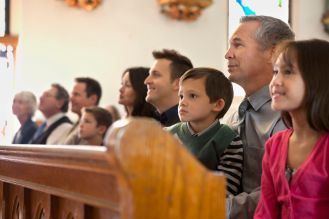
Kids in Church - Good 3I suppose the moments of peace do indeed make all of these experiences bearable.

Seeing our boys drop money in the offertory basket and give the usher a high five or having them walk beside me holding my hand on the way to Holy Communion are two such examples.

Dipping their fingers in the holy water upon entering the church to make the sign of the cross and resting in my arms with their head on my shoulder as we sing a hymn are two others.

Yes, I recognize it is all worth it (and, honestly, it’s not as bad as this account might depict). I guess that’s what keeps us returning each week.

Sure, we can take the simple route and stay home because it’s easier with little kids. But what good comes from that?

Kids in Church - Bad 1No, we’re going to keep coming back, persevering with focus on the benefits of praising God in His house, joined in solidarity with our brothers and sisters in Christ. (1 Corinthians 9:24 & Hebrews 12:1)

Our faith is important and we wish to celebrate it, teaching it to our children and practicing it with them as a family – no matter how frustrating or challenging it may be at times.

As St. Paul teaches, we will fight the good fight, we will finish the race, and we will keep the faith. (2 Timothy 4:7)

So if you’re experiencing what we do on so many Sundays, take courage and know you’re not alone.

If, on the other hand, you’ve seen our family or one like ours in your church and have been tempted to judge, please, remember compassion could bring you one step closer to Heaven.

Now then, you’ll have to excuse me – my wife and I need to plan our strategy for tomorrow.

Soft like a Sponge

My wife and I recently took our kids to a family camp for a summer holiday, looking to relax away from the city while creating new memories.

I should point out this was technically a faith-based retreat, as the families attending were all Catholic and seeking to grow in identity as families rooted in Christ’s love and teaching.

One of the activities at the camp was communal meal time. Families all ate together in the dining hall at their respective tables, while pitching in with clean-up chores afterwards.

Personally, I loved dishwashing duties.

With soap suds halfway up my arms and a sponge in hand, it was gratifying to help out after each meal while chatting with people about a wide variety of topics.

Sponge 1As the week progressed, I found myself more and more focused on the sponge when I was washing dishes – all thanks to a priest, believe it or not.
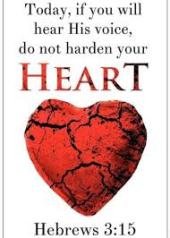
You see, during a morning Mass early in the week, the on-site priest made a comparison in his homily between a person’s heart and both a sponge and a rock.

As we were reminded, Jesus teaches our hearts are to be open, merciful and filled with love for everyone. In other words, they are to be soft like a sponge.

Conversely, people’s hearts can also be jaded, closed to those different from them in any way or scarred by unfortunate life experiences, thus making them extremely hard like a rock.

I was struck by the image of a sponge, as well as the Biblical passage which cautions us against hardening our hearts. (Hebrews 3:15)

Sponge 2Reaching for the sponge each day or night after a meal that week, I couldn’t help but think of that sermon, wondering what kind of heart mine was.

Now back home, I am still challenged to assess who I am inside each time I scrub some dishes in the kitchen.

Do I exhibit a hardened heart, irritated by those around me?

Is my heart open to others, willing to accept them and introduce them to who I am?

When dry, the sponge beside our sink is rough and crusty. Hard to bend, it features an abrasive side that scratches your skin.

Once immersed in warm water, however, the sponge immediately becomes squishy, so flexible that you can squeeze it into different forms when scrubbing dishware of various shapes and sizes.

I can appreciate how a lot of our hearts can be like this today.

On the surface – and for whatever reason – many of us can at first be firm or cold to others, giving an impression that can rub people the wrong way.

And yet, once comfortable enough to let down our guard, we allow people to get to know our true self, welcoming them to discover our wonderful personality.

Clearly, our hearts, much like a sponge, are most effective when soft.

Sponge 5And just as a sponge absorbs and retains water, a warm heart invites others to enter into our lives, allowing us to begin and nurture positive, meaningful relationships.

But let’s not forget a sponge soaks up water only to wring out the excess.

Similarly, we are called by God to fill our hearts with His grace, learning and living out Jesus’ Gospel, and then pour out our hearts to the world, enabling everyone to encounter God’s unconditional and eternal love. (Matthew 28:19-20)

So the next time you’re scrubbing a pot or swiping some cutlery with a soapy sponge, try to pause if only for a moment, and recognize how soft your heart can be, filled with love waiting to be given to the world.